
Abstract
This paper explores STEM (Science, Technology, Engineering, Mathematics) as a transformative framework in primary education, emphasizing its role as a discipline, strategy, and skillset. Here, STEM isn’t just restricted to Science and Math subjects but also integrates Reading, Art, and Mental Health implicitly. This paper examines pedagogical approaches, including Computational Thinking, Design Thinking, and Scientific Inquiry; and proposes a grade-specific skill progression model.
The paper breaks the postulates constituted within the Computational Thinking, Design Thinking and Scientific Inquiry framework, discussing various pedagogical approaches prevalent from Kindergarten to Grade 5, mapping each sub-part to teaching objectives and learning outcomes expected across all Indian and International boards operating in India.
Through structured methodologies and interactive learning environments, this paper highlights how STEM fosters critical thinking, creativity, self-management, and problem-solving, preparing learners to address complex real-world challenges, along with possible assessment strategies that can be adopted by schools and facilitators.
1. Introduction
STEM education integrates the foundational disciplines of science, technology, engineering, and mathematics into a cohesive learning paradigm. It expands beyond these domains to include art, reading, and mental health, creating a holistic educational framework that nurtures creativity, critical thinking, and innovation.
STEM can be understood in three dimensions:
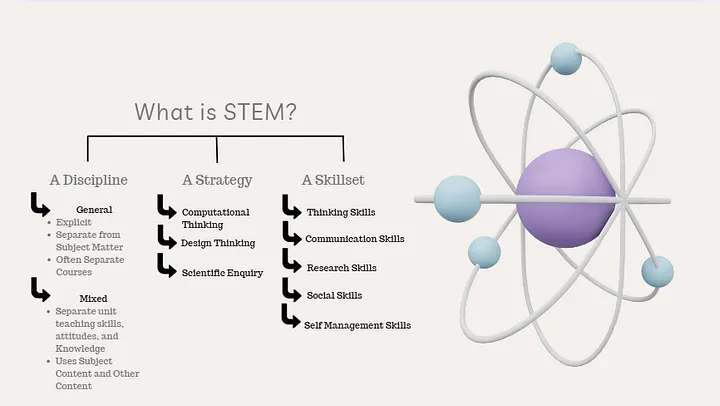
- As a Discipline: Explicit teaching of subject knowledge and technical skills.
- As a Strategy: An interdisciplinary approach connecting concepts, form, and function to solve problems.
- As a Skillset: Building capacities like critical thinking, inquiry, communication, and self-management.
As a pedagogical framework, STEM serves as the connective tissue between concept, form, and function, enabling students to apply their learning in meaningful ways.
In a school framework, STEM can be treated in a silo, an independent discipline, or can be integrated as an interdisciplinary strategy to explain various concepts using Computational Thinking, Design Thinking, and Scientific Inquiry as techniques; or as a method to develop Self Management, Critical Thinking, Research, Communication, and social skills.
This paper endeavours to offer a framework for Primary Schools to integrate STEM as a strategy to develop Self Management, Critical Thinking, Research, Communication, and Social Skills, while focussing on developing a strong relationship between Form, Function, Causation, Change, Connection, Perspective, Responsibility and Reflection across all the concepts enumerated in the Primary School syllabus across all boards National and International, operational in India.
3. Pedagogical Approaches to STEM
3.1: Computational Thinking
Computational thinking (CT) involves solving problems by formulating them into algorithms that can be implemented by humans or machines. Key stages include:
- Formulation: Using research and self-management skills for information literacy.
- Decomposition: Breaking down problems into manageable parts through mindfulness and reflection.
- Abstraction: Focusing on creative thinking, including originality and elaboration.
- Algorithm Design: Employing critical thinking and transfer skills to develop structured solutions.
- Debugging: Refining solutions with critical thinking and metacognition.
- Iteration and Transfer: Enhancing ideas through testing and adaptation.
The integration of computational thinking with K-12 science education adds depth by leveraging agent-based computation, where students model dynamic and emergent phenomena. This approach aligns computational thinking practices, such as abstraction and simulation, with scientific reasoning, enabling learners to understand complex systems through programming and modelling tools (Sengupta et al., 2013).
3.2: Design Thinking
Design thinking fosters creativity and problem-solving by engaging students in iterative and user-focused approaches. While traditionally associated with professional fields like engineering and art, recent research emphasizes its relevance across all educational disciplines, particularly STEM. Design thinking in STEM involves cognitive processes such as ideation, prototyping, and testing, where students apply cross-disciplinary knowledge to real-world challenges.
A study by Alashwal (2020) highlights that STEM education, when integrated with design thinking, prepares students to tackle complex technological advancements by nurturing creative and innovative skills. Key features include:
- Developing a Design Mindset: Encouraging students to see failure as a steppingstone to iterative improvement.
- Connecting Disciplines: Using science and mathematics to inform design and engineering projects.
- Hands-On Application: Introducing students to tangible problem-solving tasks that require planning, execution, and refinement.
These activities allow students to develop not only technical skills but also empathy and collaborative problem-solving, equipping them for interdisciplinary challenges. By embedding design thinking into the curriculum, educators can address the gap between theoretical knowledge and practical application.
The steps for Design Thinking broadly include:
- Empathize: Developing social-emotional intelligence to understand perspectives.
- Define: Articulating clear, evidence-based problem statements using research skills.
- Ideate: Brainstorming innovative solutions collaboratively.
- Prototype: Building tangible representations of ideas.
- Test: Using feedback and reflection to refine prototypes.
3.3: Scientific Inquiry
Scientific inquiry provides a structured methodology for answering questions and creating logical explanations. Its core elements include:
- Ask Questions: Encouraging curiosity and inquiry through communication and social skills.
- Form Hypotheses: Using critical and research skills to make informed predictions.
- Conduct Experiments: Collecting data through organized and collaborative methods.
- Analyze Data: Evaluating results critically.
- Draw Conclusions: Reflecting on outcomes to generate new knowledge (National Research Council, 2008).
4. Grade-Specific STEM Integration
In order to successfully implement STEM as a strategy, it is important to zero down on the teaching objectives and the expected outcomes, emergent from each activity adopted. While the teaching objectives can be fluid, depending upon the interdisciplinary concept STEM is being integrated with, it is important to note that the outcomes expected from each student from the STEM integration, need to be largely skill based.
For example, a unit on understanding Math operations integrated with STEM, could involve having students run a bakery at the end of the unit. While the Math outcomes would cover understanding of the concepts behind operations, the STEM outcomes would cover skills under critical thinking and data interpretation.
Under the scope of this paper, we have stuck to three major strategies under STEM, as detailed out before: Critical Thinking, Design Thinking, and Scientific Inquiry, and have mapped each sub part of the above 3 processes to grade level expectations with regard to Critical Thinking, Self-Management, Communication, Research, and Social Skill outcomes.
This section outlines the progression of STEM integration, including skill development and tool use, from pre-nursery to grade 5. It emphasizes the incorporation of computational, design, and inquiry-based methods in each grade level, thus offering facilitators and schools a framework to base assessment patterns and create learning journeys pertaining to STEM, for each student.
4.1: Pre-Primary
- Categorize data to observe patterns
- Understand and Attache emotions to creations and ideas that originate in the class
- Elementary understanding of simple problems, patterns, and why and how can we solve the same.
- Build Creative ideas based on feelings and reflections.
- Observe how things are made :Use techniques like art, craft, origami, gardening
4.2: Grade 1
- Categorize given data to solve simple problems
- Acquire a rudimentary understanding of how and why information is gathered, to solve any problem
- Building original ideas that are creative but not necessarily scientific.
- Understand the steps involved in building an idea.
- To be able to reflect on what worked in an experiment and what did not.
- Using techniques like craft, sculpting, simple thread-work with adult intervention, art skills, sustainability, origami to design the product.
4.3: Grade 2
- · Gather and categorize data to solve simple problems
- · Derive questions from visuals and information acquired.
- · Use adult help to understand how information needs to be broken down, to identify problems to be solved.
- · Build original ideas based on cause-and-effect relationships observed around them, not necessarily an objective outcome of information gathered.
- · Understand the need for jotting down a step-by-step approach, before building a prototype.
- · To reflect upon what worked and what did not, and think of ways to improve their idea
- · Use techniques like laser cutting for simple shapes, sculpting, simple thread-work under adult supervision and with minimal intervention, origami, patch work, scratch programming, sustainability, art and craft skills to design the product.
4.4: Grade 3
- Gather and organize information to identify problems to solve
- Break down information to identify problem areas with adult help.
- Structure clear and contextual questions.
- Arrive at original ideas based on information broken down, with the help of an adult.
- Have a basic understanding of why building an algorithm is important and create a basic approach to build an idea. The algorithm need not be detailed. E.g: during an experiment, students jotted down the process.
- To use the information gathered, to identify gaps in their prototype, and identify ways to rectify them. After gaps have been identified, seeking knowledge and attempting to build a better version.
- Using techniques like laser cutting, sculpting, thread-work, patchwork, art and craft skills, simple animation skills, sustainability, basic video editing, design software, to design the product.
4.5: Grade 4
- Gather, assess, break down information, to zero down on problems
- Structure clear and thought provoking questions based on the information gathered.
- Draw observations and use self management skills to record primary data
- Break down information keeping in mind given parameters, zeroing down on problem areas to be solved, with adult help.
- Arrive at original ideas based on Information broken down based on parameters defined with adult help. Perspective may be derived with adult help. Teamwork initiated.
- Use critical thinking, transfer skills, and organizational skills to build step by step approaches to simplify/ break an idea down into a step by type approach, with the help of an adult
- Accept and analyze feedback, and understand the strengths and weaknesses in their prototype, then use research skills to identify how the gaps would be filled.
- Seeking knowledge and identifying ways to build a better version with adult intervention.
- Use techniques like laser cutting, electronics, sculpting, thread-work, patchwork, tapestry, video editing, stop animation, sustainability, art and craft skills to design the product.
- Collaborative projects with computational models; explore scientific phenomena like energy transfer or weather patterns.
4.6: Grade 5
- Gather, Assess, Analyze, and Synthesize information, to identify problems that they have the potential to solve.
- Structure clear and thought-provoking questions based on the information gathered.
- Ability to draw effective observations and use self-management skills to record primary data
- Synthesise information to arrive at a suitable hypothesis, keeping in mind their resources and skillsets. Articulating their hypothesis with reasonable effectiveness.
- Arrive at original ideas based on a synthesis of a variety of information. This synthesis involves multiple perspectives and teamwork.
- Use critical thinking, transfer skills, and organizational skills to understand the idea generated, not just as a solution but as a process.
- Accept and analyze feedback and reflect upon the prototype, to understand its strengths and weaknesses, thereafter research and organize information, to fill the gaps
- Seek knowledge and identifying ways to fill the same, to build a refined version with the help of an adult.
- Use techniques like 3d printing and laser cutting, robotics, basic programming, sculpting, thread-work, patchwork, tapestry, video editing, design software, sustainability, art skills to design the product.
- Engage in iterative modeling with tools like CTSiM (Computational Thinking using Simulation and Modeling) to understand emergent systems (e.g., population growth); promote independent thinking and abstract reasoning.
5. Assessment Strategies in STEM
5.1: Definition of Assessment
Assessment is the process of reasoning from evidence to determine what a student knows or can do. It involves designing tasks that enable observable demonstrations of knowledge or skills and making inferences based on an underlying model of cognition. (National Research Council, 2001)
5.2: Goals of Assessment in STEM According to the National Research Council (2001), assessments serve three main purposes:
- Formative Assessments: Provide real-time feedback during instruction to identify student progress, strengths, and areas for improvement.
- Summative Assessments: Measure individual achievement, often at the conclusion of a unit or course, to assign grades or determine performance levels.
- Program Evaluation: Evaluate the effectiveness of educational programs or curricula.
5.3: Approaches to Assessing STEM
- Artifact/ Project Analysis:
- Create skill-based outcomes and map them across relevant rubrics across a period of time. Ensure these outcomes and timeframes are shared or discussed with the students in advance. Evaluate growth within the decided outcomes over a period of time.
- Create learning journeys that are limited to the academic year, and those that are transient across academic years, to evaluate grade level metrics as well as year on year growth.
- Assessment or Reflections
- These involve self-assessments made by students, basis their understanding of their own performance.
- Reflections of what students could have improved upon, or the limitations they worked under, are reflective of each student’s critical thinking, and debugging or iteration skills.
- Technology-Enhanced Assessments:
- Use simulations, games, and interactive tools to assess problem-solving in authentic contexts.
- Collect data on both process and outcomes, offering insights into student strategies (Weintrop et al., 2021)
5.4: Challenges in Creating Assessments
- Defining Constructs: Identify the specific knowledge, skills, or practices to be measured.
- Contextual Alignment: Tailor assessments to reflect the learning environment and ensure they evaluate the intended constructs without bias.
- Equity and Accessibility: Avoid reliance on prior knowledge or technological access that might disadvantage some students.
- Integration Challenges: Balancing computational thinking (CT) assessment within broader subject areas like science or math.
- Measuring Processes and Objectives vs. Outcomes: Balancing assessment of student processes (e.g., debugging) with evaluating final products.
5.5: How Assessment Informs Teaching
- Formative Assessments: Offer actionable insights for educators to adapt instruction and target specific learning gaps.
- Feedback Mechanisms: Provide detailed, constructive feedback to students, enabling iterative improvement and deeper learning.
_________________________________________________________________
6. Benefits of Integrating Computational Thinking, Design Thinking, and Scientific Inquiry in STEM
Integrating computational thinking, design thinking, and scientific inquiry within STEM education creates a cohesive educational framework that fosters student engagement and critical skill development. These pedagogies complement each other, bridging the gap between abstract concepts and practical, real-world applications.
Agent-based computation, as exemplified by platforms like Computational Thinking using Simulation and Modeling (CTSiM), plays a pivotal role in this integration. CTSiM enables students to construct, simulate, and refine computational models of scientific phenomena, such as population dynamics or energy transfer. The use of visual programming tools within CTSiM removes barriers associated with traditional coding syntax, allowing students to focus on conceptual understanding and systems thinking (Sengupta et al., 2013).
When combined with scientific inquiry, computational thinking amplifies students’ ability to engage with causal reasoning and iterative testing. Inquiry-based learning involves forming hypotheses, designing experiments, and analyzing results, aligning seamlessly with computational thinking practices like abstraction, debugging, and simulation. This iterative process mirrors real-world practices in science and engineering, fostering a deeper comprehension of complex systems and encouraging a mindset of continuous improvement (National Research Council, 2008).
Design thinking further enriches this framework by fostering creativity and user-centered problem-solving. Activities such as prototyping, testing, and redesigning provide students with opportunities to apply interdisciplinary STEM knowledge to tangible innovations (Alashwal, 2020).
7. Implications for Educators
Educators should scaffold STEM integration by:
- Aligning activities with students’ developmental levels.
- Introducing agent-based computation tools to simplify complex concepts.
- Providing iterative feedback loops to support refinement and reflection.
- Integrating visual programming environments to lower barriers to entry and enhance engagement.
- Allowing time for design thinking projects, to develop empathy and creative thinking
- Ensuring Scientific Inquiry transcends to even social science subjects like history, geography, economics, political science, psychology and sociology.
8. Conclusion
STEM education, enhanced by Computational Thinking, Design Thinking, and Scientific Inquiry, provides a robust framework for developing critical 21st-century skills. Students are better equipped to think critically, innovate creatively, and address real-world challenges.
STEM education. However, needs a robust assessment framework that enables facilitators and educational institutions to map each child’s skillsets effectively, thus nurturing and progressively building upon them. While adoption of STEM strategies lead to the holistic development of a child, strengthening the same with a robust framework can unleash the transformative potential of STEM education, bridging the gap between theoretical knowledge and practical application.
References
1. Development and Validation of New Objective School Achievement Tests in the STEM Field for Primary School Students: https://www.rhgraham.org/resources/WhenSTEMaquestionofage1.sflb.pdf
2. Guidelines for STEM Activities at Pre-School Level: Erasmus Plus Project.
3. K4K-Guidelines-EN-pt1.pdf : https://ec.europa.eu/programmes/erasmus-plus/project-result-content/1f3081f5-291f-45ec-8cb3-b97cde56256e/K4K-Guidelines-EN-pt1.pdf
4. Weintrop, D., Rutstein, D., Bienkowski, M., & McGee, S. (2021). Assessment of Computational Thinking. Computational Thinking in Education.
5. Sengupta, P., Kinnebrew, J. S., Basu, S., Biswas, G., & Clark, D. (2013). *Integrating computational thinking with K-12 science education using agent-based computation: A theoretical framework*. *Education and Information Technologies, 18*(2), 351–380. DOI: [10.1007/s10639–012–9240-x](https://doi.org/10.1007/s10639-012-9240-x)
6. Siew, N. M., & Ambo, N. (2020). The scientific creativity of fifth graders in a STEM project-based cooperative learning approach. Problems of Education in the 21st Century, 78(4), 627–643. DOI: 10.33225/pec/20.78.627.
7. Alashwal, M. (2020). Design Thinking in STEM Education: A Review. International Research in Higher Education, 5(1), 18–26. DOI: 10.5430/irhe.v5n1p18.
8. National Research Council. (2008). Taking Science to School: Learning and Teaching Science in Grades K-8. National Academies Press.
9. National Research Council. (2001). Knowing What Students Know: The Science and Design of Educational Assessment. Washington, DC: The National Academies Press. DOI: 10.17226/10019.
10. IB: Fostering Computational Thinking and Design Thinking in the IB PYP, MYP, and DP.
11. IB PYP Learning and Teaching